What Is a Rigger, Really? Then, Now, and the Balance That Matters
What is a rigger, exactly? What does one actually need to know, which skills are non-negotiable, and how would you sort riggers by their expertise?
Those are the questions IMIRT, the Irish game makers association, put to me over the past few weeks while they build a broad guide for their community. I started to answer, and then a different, more interesting question pulled me sideways: how did this job even come to exist, and what has it done to the people who do it?
I am not going to attempt the classification here, that is a post of its own. Instead I want to hold two pictures side by side: the rigger of today, and the rigger of the early 90s.
One caveat. I was not around in the 90s. But I spent several years working next to one of the first people who worked as a rigger in this industry, and I formed an opinion from knowing him. Everything here is my own reading of it. I will not put words in his mouth.
Riggers before there were riggers
Here is the thing that still surprises me: in the early days, a lot of animation work, VFX especially, shipped without anyone called a rigger at all.
There were animators who wanted to move a digital creature, so they built an armature and went from there. Their goal was to animate; they were artisans first. The people assembling those rigs were just the technical ones, or the frustrated ones hunting for a way to animate better and faster in a CG industry that barely existed yet. They wired up IK controls, secondary controls to fake a little muscle behaviour, small automations. There was no title. Just animators trying to make production easier.
And look at what they did not have. No tutorials, no forums, almost no documentation. Just know-how, a handful of SIGGRAPH papers on rigid skinning, and some FACS work on the face.
So the animators who kept building these systems quietly became the first riggers, and they were problem solvers above everything else. They learned from one production to the next, burning countless hours inside Softimage to bend a system around the shot in front of them. The IK they leaned on had only landed around 1992, so this was more wit than repetition. They picked it up as they went, traveling, meeting a challenge and solving it with little more than a clever idea and no internet to lean on.
They also hardly ever said no. The instinct was to find a way, because they understood the request from the inside, they were animators too in some form. On the rare occasion a demand genuinely did not serve the work they would push back, but that was the exception, not the reflex.
And piece by piece they pushed the DCCs past what those tools were ever meant to do: automating with code, working trigonometry against real shots, bending constraints and limits, rewriting deformers, an endless list. When they wanted to know how something had been pulled off, the answer was the extended-edition DVD and its breakdowns, a chat at a convention, or a pint with a colleague.
When information became free
Now the information is everywhere. Breakdowns, tutorials, documentation, high-end tools, busy forums, and lately an AI that will suggest a fix before you have finished describing the problem.
And here is my quiet worry. A large share of riggers from this generation, and of students who want to become riggers, go first to see how someone else solved it, instead of trying to figure it out themselves. The result is the same handful of solutions repeated over and over, and far fewer clever ideas crafted into the rig itself. Abundance made us faster and, in a subtle way, a little less inventive.
What a rigger actually is
To me, a rigger is first a problem solver: someone who can take a problem apart into small pieces and solve them one by one until the puzzle is whole. That does not erase the grind. Characters still have to ship, and skinning an appealing character is still tedious work. But a rigger who meets those problems with genuinely creative thinking tends to walk away with something extra: a tool, a workflow, a trick, a better or simply different way to reach the result.
The balance that matters
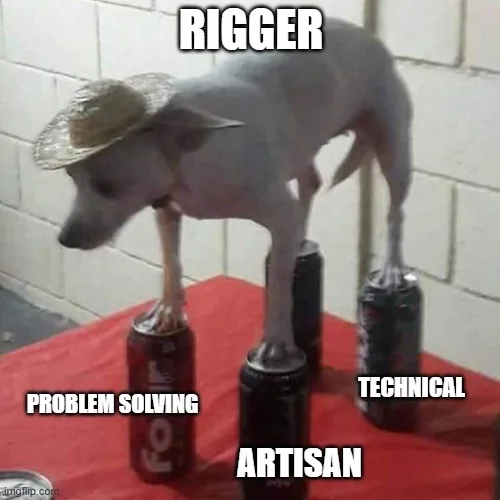
In the end a rigger is a balance of three things: problem solving, technical skill, and the artisan’s eye. Lean too hard on any single one and something breaks. The pure technician automates a problem nobody had. The pure artisan hand-fixes the same broken shot over and over. The pure problem solver builds something elegant that an animator cannot actually use. Combine a healthy chunk of all three and you get a great rigger.